I love this kid!

Hugs! Have a great week everyone!
Linda


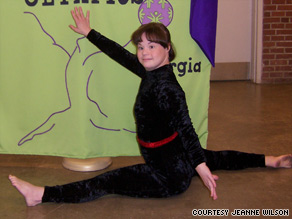
Katy Wilson says she wants her athletic successes to surprise people and give them hope.
Wilson, now 29, has won two international gold medals in the Special Olympics for her gymnastic abilities. She turns cartwheels for her floor routine and does acrobatics on the balance beam.
She also goes on public speaking tours.
"Most of all, I love doing speeches because I want them [the audience] to be surprised just how good my speeches are," she said by phone.
Wilson's story -- and countless other stereotype-bending stories like it -- is possible in part because of the dogged vision of Eunice Kennedy Shriver and the Special Olympics organization she founded more than four decades ago.
Shriver, who died Tuesday, started the organization as a sports camp for special-needs kids and adults in her backyard in Maryland in 1962. Since then, the Special Olympics has grown into a global organization that helps 3 million athletes with Down syndrome, autism and other intellectual disabilities compete for medals in an array of sports.
"She helped forever alter how people with intellectual disabilities are viewed and treated and respected," said Amie Dugan, a spokeswoman for the Special Olympics. "This is a population that 40 years ago they were beyond marginalized. They were disenfranchised from society. It was considered the status quo ... to put them in an institution and never think about that again. And she changed all of that. She brought them out into the light."
An estimated 200 million people in the world live with intellectual disabilities. That population was largely unseen and voiceless in 1968 when Shriver stepped to the microphone to announce the start of the first Special Olympic Games at Chicago's Soldier Field.
"In ancient Rome, the gladiators went into the arena with these words on their lips," she told the 1,000 athletes in the stadium. "'Let me win, but if I cannot win, let me be brave in the attempt.'"
Before the program, people with intellectual disabilities were only told what they could not accomplish, said David Tolleson, executive director of the National Down Syndrome Congress. "Special Olympics emphasizes what folks can do, and it does it in a manner that's fun and exciting and it offers a sense of community both within the family of those with developmental disabilities as well as with the greater community at large -- the volunteers who come in and have some of their misconceptions or preconceptions cast aside when they realize how much people with developmental disabilities truly are capable of."Jeanne Wilson, the mother of the gymnast with Down syndrome , started tearing up when she recounted the moment she saw her daughter -- whose future once looked so uncertain -- standing atop an awards podium with a gold medal draped around her neck.
"It was just amazing because that really gave her confidence. And I don't think people realize how much it means to a young person who you might have thought did not have a future or might not ever have a chance to walk," she said. "To see her doing a routine on balance beam or a floor routine is pretty amazing."
Katy Wilson, who lives in Gainesville, Georgia, continues to train as a gymnast. She also goes bowling with a group of Special Olympians most Fridays. They call themselves the Alley Kats, and Wilson describes the bowlers as some of her best friends.
"I love bowling because it is so much fun being out there being able to have friends," she said. "It's exciting to do bowling because I get a lot of scores."
When she's not in training, Wilson works at a steakhouse as a hostess.
"I get their coffee, I get their bread, I get their drinks, I do the silverware, I sweep up, I do the hostess," she said. "Oh, I love the job because everybody's so nice to me, especially the managers, they give me hope and they're so excited to have me there and I'm so happy to be there with them."
As a global ambassador for the Special Olympics, Wilson tours the country telling people about her life story. She says she hopes it reminds them that everyone can succeed with a positive attitude.
She grew up watching her sister do cartwheels as a cheerleader.
She modeled her life in her sister's image, but she forged a life that's all her own.Shriver had suffered a series of strokes in recent years and died at Cape Cod Hospital, her family said in a statement. Her husband, her five children and all 19 of her grandchildren were by her side, the statement said.
"She was the light of our lives, a mother, wife, grandmother, sister and aunt who taught us by example and with passion what it means to live a faith-driven life of love and service to others," the family said.
The hospital is near the Kennedy family compound, where her sole surviving brother, Sen. Edward Kennedy, has been battling a brain tumor.
Sen. Kennedy said his earliest memory of his sister was as a young girl "with great humor, sharp wit, and a boundless passion to make a difference."
"She understood deeply the lesson our mother and father taught us — much is expected of those to whom much has been given," he said in a statement. "Throughout her extraordinary life, she touched the lives of millions, and for Eunice that was never enough."
President Barack Obama said Shriver will be remembered as "as a champion for people with intellectual disabilities, and as an extraordinary woman who, as much as anyone, taught our nation — and our world — that no physical or mental barrier can restrain the power of the human spirit."
As celebrity, social worker and activist, Shriver was credited with transforming America's view of the mentally disabled from institutionalized patients to friends, neighbors and athletes. Her efforts were inspired in part by the struggles of her mentally disabled sister, Rosemary.
Peter Collier, author of "The Kennedys, an American Drama," called Eunice Shriver the "moral force" of the Kennedy family.
"We have always been honored to share our mother with people of good will the world over who believe, as she did, that there is no limit to the human spirit," her family members said in the statement.
Shriver was also the sister of Sen. Robert F. Kennedy, the wife of 1972 vice presidential candidate and former Peace Corps director R. Sargent Shriver, and the mother of former NBC newswoman Maria Shriver, who is married to California Gov. Arnold Schwarzenegger. With Eunice Shriver's death, Jean Kennedy Smith becomes the last surviving Kennedy daughter.
Schwarzenegger said his mother-in-law "changed my life by raising such a fantastic daughter, and by putting me on the path to service, starting with drafting me as a coach for the Special Olympics."
A 1960 Chicago Tribune profile of the women in then-candidate JFK's family said Shriver was "generally credited with being the most intellectual and politically minded of all the Kennedy women."
When her brother was in the White House, she pressed for efforts to help troubled young people and the mentally disabled. And in 1968, she started what would become the world's largest athletic competition for mentally disabled children and adults. Now, more than 1 million athletes in more than 160 countries participate in Special Olympics meets each year.
"When the full judgment on the Kennedy legacy is made — including JFK's Peace Corps and Alliance for Progress, Robert Kennedy's passion for civil rights and Ted Kennedy's efforts on health care, work place reform and refugees — the changes wrought by Eunice Shriver may well be seen as the most consequential," Harrison Rainie, author of "Growing Up Kennedy," wrote in U.S. News & World Report in 1993.
It was Shriver who revealed the condition of her sister Rosemary to the nation during her brother's presidency.
"Early in life Rosemary was different," she wrote in a 1962 article for the Saturday Evening Post. "She was slower to crawl, slower to walk and speak. ... Rosemary was mentally retarded." Rosemary Kennedy underwent a lobotomy when she was 23, though that wasn't mentioned in the article. She lived most of her life in an institution in Wisconsin and died in 2005 at age 86.
The roots of the Special Olympics go back to a summer camp Shriver ran in Maryland in 1963. Shriver would "get right in the pool with the kids; she'd toss the ball," said a niece, former Maryland Lt. Gov. Kathleen Kennedy Townsend, who volunteered at the camp as a teen. "It's that hands-on, gritty approach that awakened her to the kids' needs."
Realizing the children were far more capable of sports than experts said, Shriver organized the first Special Olympics in 1968 in Chicago. The two-day event drew more than 1,000 participants from 26 states and Canada.
By 2003, the Special Olympics World Summer Games, held that year in Dublin, Ireland, involved more than 6,500 athletes from 150 countries. The games are held every four years.
Well into her 70s, Shriver remained a daily presence at the Special Olympics headquarters in Washington.
"Today we celebrate the life of a woman who had the vision to create our movement," said Special Olympics President and COO Brady Lum.
"In her memory, we will continue to work to bring her powerful vision to life to change the lives of those with intellectual disabilities, their families and communities, using sports as the catalyst for respect, acceptance and inclusion."
Juvenile delinquency was another issue that interested Shriver and spurred her to action. In his 1991 book "The Promised Land: The Great Black Migration and How It Changed America," author Nicholas Lemann said the Kennedy administration's juvenile delinquency commission, "a pet project that had been created to placate Eunice," became the precursor of the vast federal effort to improve the lot of urban blacks.
After he took office, President Lyndon B. Johnson tapped R. Sargent Shriver to lead his War on Poverty.
Eunice Shriver was the recipient of numerous honors, including the nation's highest civilian award, the Presidential Medal of Freedom, which she received in 1984. In May, the National Portrait Gallery installed a painting of her — the first portrait commissioned by the museum of someone who had not been a president or first lady.
Shriver was born in Brookline, Mass., the fifth of nine children to Joseph P. Kennedy and Rose Fitzgerald Kennedy. She earned a sociology degree from Stanford University in 1943 after graduating from a British boarding school while her father served as ambassador to England.
She was a social worker at a women's prison in Alderson, W.Va., and worked with the juvenile court in Chicago in the 1950s before taking over the Joseph P. Kennedy Foundation with the goal of improving the treatment of the mentally disabled. The foundation was named for her oldest brother, Joseph Jr., who was killed in World War II.
In 1953, she married Shriver. He became JFK's first director of the Peace Corps, was George McGovern's vice-presidential running mate in 1972, and ran for president himself briefly in 1976.
Survivors include her husband, who was diagnosed with Alzheimer's disease in 2003, and the couple's five children: Maria Shriver, who is married to Schwarzenegger; Robert, a city councilman in Santa Monica, Calif.; Timothy, chairman of Special Olympics; Mark, an executive at the charity Save the Children; and Anthony, founder and chairman of Best Buddies International, a volunteer organization for the mentally disabled.
Mark Shriver once said his parents' actions, not just words, influenced their children.
"In the course of our upbringing, they stressed the importance of giving back," he said. "But we didn't sit around having family discussions about it. We learned by what she and my father were doing."


 Have a great day everyone!


 The proud mothers of these beautiful girls have been asked to do a presentation on Down Syndrome at the Virginia General Federation of Women's Clubs state convention on August 15th. I would like to solicit the help of my blogger friends for part of my presentation. If you would, please leave me a comment regarding the following: